How Tax Brackets Actually Work (And What They Mean for You)
A clear breakdown of how marginal tax brackets work, why a raise won't push all your income into a higher rate, and how to read your paycheck with confidence.
Sponsored
The Myth That Trips Everyone Up
Here’s a worry that comes up almost every time someone gets a raise or a bonus: “If I make more money, won’t I lose it all to a higher tax bracket?” It’s a reasonable question, but it’s based on a misunderstanding of how tax brackets work.
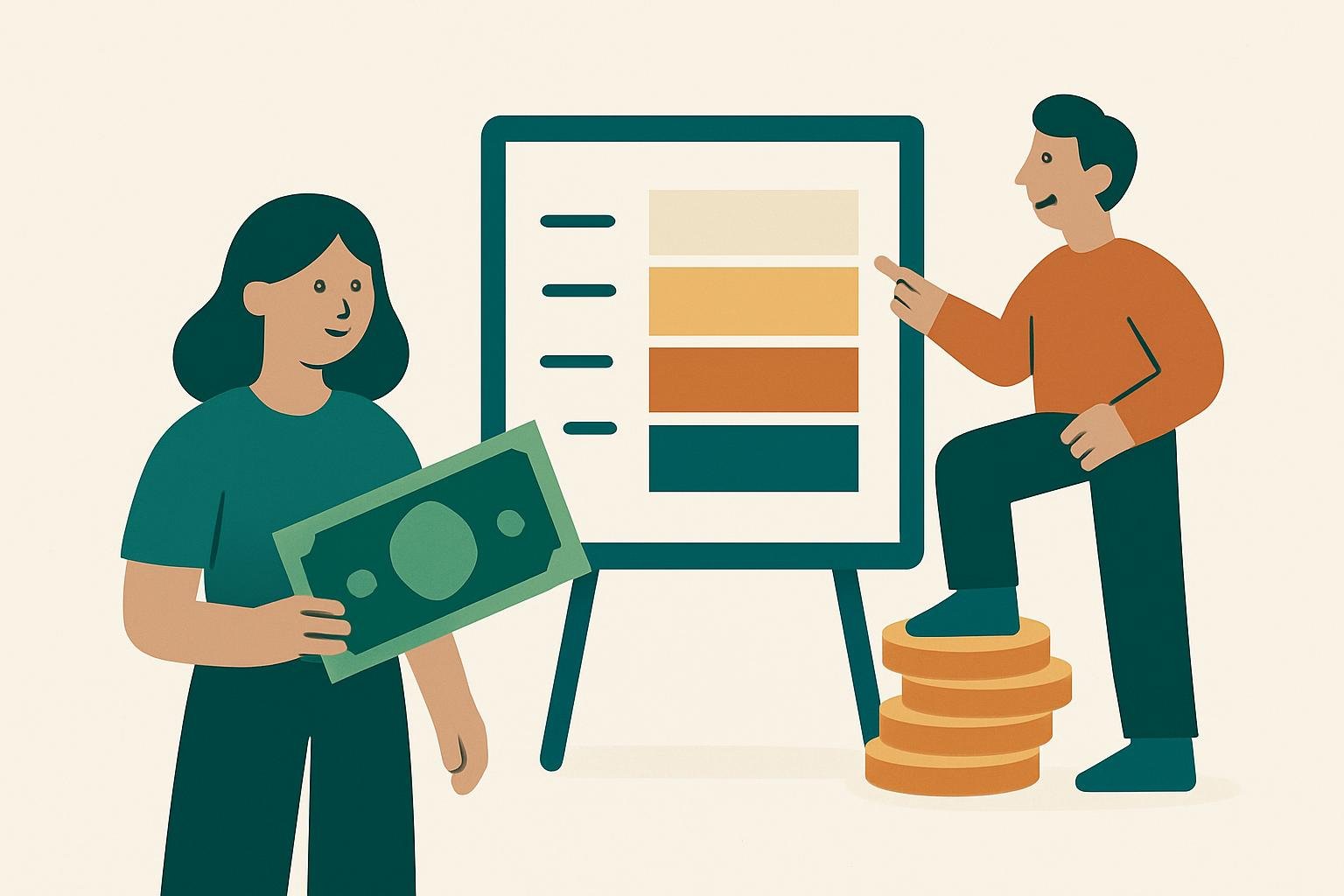
A tax bracket is a range of income taxed at a specific rate. In the United States, the federal income tax system uses several brackets, each with its own rate, and the rates increase as income increases. That part is true. What trips people up is assuming that once your income crosses into a higher bracket, your entire income gets taxed at that higher rate. It doesn’t. Only the portion of your income that falls within that bracket gets taxed at that rate.
What “Marginal” Actually Means
The term you’ll hear is “marginal tax rate.” Marginal just means “at the edge” or “the next dollar.” Your marginal rate is the rate applied to the last dollar you earn, not to every dollar you earn.
Think of your income as water filling a series of buckets, stacked one on top of the other. The first bucket holds the lowest amount of income, and it fills up at the lowest tax rate. Once that bucket is full, any additional income spills into the next bucket, which is taxed at a slightly higher rate. Only the income that spills into a bucket gets taxed at that bucket’s rate. The income sitting in the earlier, lower buckets keeps its lower rate.
So if you move into a higher bracket, you’re not paying that higher rate on everything you earned. You’re only paying it on the slice of income that falls inside that new bracket.
A Simple Walkthrough
Let’s use round, made-up numbers to keep the math easy to follow, not to represent actual current tax brackets.
Imagine a system with three brackets:
- The first $20,000 of income is taxed at 10%
- Income from $20,001 to $50,000 is taxed at 15%
- Income above $50,000 is taxed at 25%
Now say you earn $60,000 in a year. Here’s how the tax actually gets calculated:
- The first $20,000 is taxed at 10%, which comes to $2,000
- The next $30,000 (from $20,001 to $50,000) is taxed at 15%, which comes to $4,500
- The remaining $10,000 (from $50,001 to $60,000) is taxed at 25%, which comes to $2,500
Add those up and your total tax is $9,000. That works out to an average tax rate of about 15% of your total income, even though your top marginal rate is 25%. Notice that the 25% rate only touched the $10,000 that landed in the top bracket. It never applied to the full $60,000.
Why This Matters for Raises and Bonuses
This is the part that puts people’s minds at ease. If you get a raise that pushes part of your income into a higher bracket, you will never take home less money overall because of it. Only the new, additional income is taxed at the higher rate. Every dollar you were already earning keeps its previous, lower rate.
So a raise, a bonus, or extra freelance income will never cause your take-home pay to shrink. It might grow a bit less than the full amount you were promised, because part of it gets taxed at your new marginal rate, but you always come out ahead in real dollars.
Reading Your Own Paycheck
Your paycheck withholding is an estimate, calculated based on your expected annual income, filing status, and any adjustments you’ve listed on your W-4 form, the document that tells your employer how much tax to hold back from each paycheck. Because it’s an estimate, it won’t always match your actual tax bill exactly. That’s normal, and it’s why some people get a refund and others owe a bit when they file.
If you want to understand what’s actually happening with your paycheck, look at your pay stub’s year-to-date totals rather than a single pay period. A single check can look confusing if a bonus lands in it, since bonuses are often withheld at a flat rate that doesn’t reflect your actual marginal rate. Over the full year, though, everything gets reconciled when you file your tax return.
What You Can Actually Do With This
Understanding marginal rates gives you a few practical advantages:
- Don’t turn down a raise or extra work out of bracket fear. More income always means more take-home pay, even after taxes.
- Use your average tax rate, not your marginal rate, to judge your real tax burden. Your average rate is your total tax divided by your total income, and it’s almost always noticeably lower than your top bracket.
- Think about bracket-crossing moments when timing income. If you’re self-employed or have some control over when you receive bonuses or investment gains, spreading income across two tax years can sometimes keep more of it in a lower bracket.
- Check your W-4 after a big income change. A new job, a raise, or a second income source can shift what you owe, and adjusting your withholding can prevent a surprise bill or an oversized refund.
Tax brackets look intimidating on paper, but the underlying idea is simple: you pay a little more only on the portion of income that’s new, not on everything you’ve already earned. Once that clicks, a lot of the anxiety around raises, bonuses, and “getting bumped into a higher bracket” tends to disappear.
Remember: this guide is general information, not professional advice for your specific situation. For decisions with real stakes, check with a qualified professional.